Advertising: This article contains affiliate links. We may receive a commission at no extra cost to you.
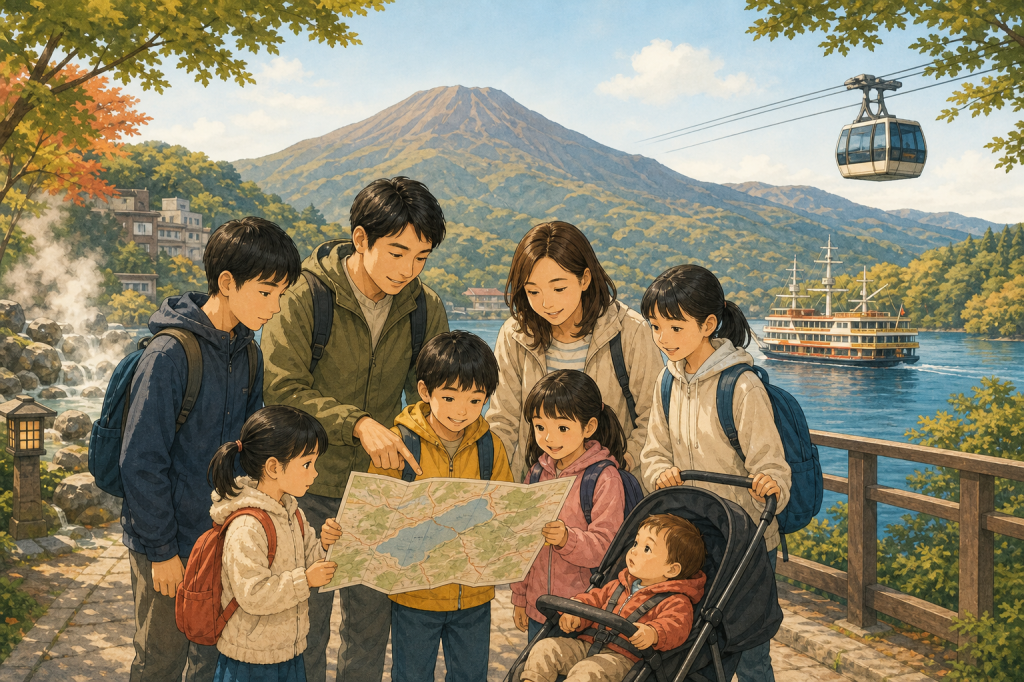
This research-based two-day Hakone itinerary is for a large family travelling from outside the area with children of very different ages—from a baby or toddler to elementary-age children and teenagers. It plans around toilets, naps, meals, stroller limits, hotel room capacity, and an early journey home.
Short answer: choose one main attraction per day
The itinerary uses the Hakone Open-Air Museum on Day 1 and the swimsuit area at Hakone Kowakien Yunessun on Day 2. This is deliberately slower than the standard Hakone loop. A family with six children can lose a surprising amount of time to toilet visits, feeding, changing clothes, finding everyone after a split, and moving luggage. A plan that looks half-empty on paper may be full in practice.
The assumed group includes a toddler, elementary-age children, and teenagers. If two adults and six children travel together, the party has eight people. Many rooms cannot legally or practically hold the whole group, so confirm the room arrangement before building the sightseeing plan.
This is a researched planning itinerary, not a first-person trip report. Opening days, admission rules, transport operations, and hotel occupancy conditions can change. The information on this page was last checked on August 26, 2026; verify each official source again before booking and departure.
Age and facility check
| Need | Hakone Open-Air Museum | Yunessun |
|---|---|---|
| Baby or toddler | Official guidance lists free stroller loans and a nursing room. Outdoor slopes still require time and rest. | Official FAQ lists baby rooms, changing tables, hot water for formula, a microwave, and permission to bring baby food. |
| Elementary-age child | Interactive artworks and play spots give younger children something active to do. | The swimsuit area can be the main physical activity of the day. |
| Teenager | Teens can explore sculpture, scenery, and photography at their own pace. | They can stay active without being limited to a toddler-only attraction. |
| Stroller | A free loan service is published, but availability should not be assumed. | Strollers are allowed, but the facility says it is not completely barrier-free and has steps and stairs. |
| Rain | The outdoor portion becomes less practical; shorten the visit. | An indoor-focused day is easier to maintain, subject to admission limits. |
Two-day itinerary with realistic buffers
| Approximate time | Plan | Why the buffer matters |
|---|---|---|
| Day 1, 9:30 | Arrive at Hakone-Yumoto or your hotel parking area | With public transport, use luggage forwarding before its outbound cut-off. Strollers are not accepted by that service. |
| 10:00–11:00 | Travel towards Chokoku-no-Mori | Allow roughly 30 minutes within this block for toilets, snacks, and a slow transfer. |
| 11:00–14:00 | Hakone Open-Air Museum and lunch | Find the nursing room and agree on a family meeting point immediately after entry. |
| 14:00–15:00 | Travel to the hotel | Do not add another attraction just because the map shows one nearby. |
| 15:00–17:00 | Check in, nap, bathe, and reorganise | The toddler can sleep while older children use appropriate hotel facilities with an adult. |
| Day 2, 9:30–13:30 | Yunessun swimsuit area | Locate baby rooms, changing rooms, toilets, and the family meeting point before anyone separates. |
| 13:30–15:00 | Lunch, changing, and a quiet break | Leave earlier if the youngest child is tired; do not make the exit time a test of endurance. |
| After 15:00 | Start the journey out of Hakone | The family still has a long drive or train ride to another prefecture. |
Day 1: do not make everyone follow the same museum pace
The Open-Air Museum officially describes interactive works that children can enter and play in, as well as family play spots. That makes it more flexible than a quiet gallery where every child must move in one line. However, flexibility only helps if the family has a simple coordination rule.
Choose one obvious meeting place and a meeting time before splitting. One adult can stay with the toddler and younger children near play areas and benches. The other adult can allow teenagers to see selected works at a faster pace. Keep phones with the adults rather than depending on every child to communicate independently.
Lunch should not become the last item after sightseeing. A hungry toddler can end the visit for everyone. Put lunch inside the museum block, then leave by about 14:00 even if some works remain unseen. The unfinished section is less costly than losing the hotel rest period.
Day 2: check changing-room rules before entering Yunessun
Yunessun’s official FAQ is unusually useful for families. It says baby food may be brought in, and the baby rooms have nursing chairs, changing tables, bins, sinks, hot water for formula, and a microwave. It also says strollers can be used after wheel disinfection, but the building is not completely barrier-free.
The FAQ states that children aged seven and over must use the changing room, bath, and toilet matching their sex under the applicable rule. There is an all-gender changing room, but showers are separated by sex. Before arrival, decide which adult will help which child. This prevents an awkward discussion while six children are waiting with bags and swimwear.
Set a meeting location that does not depend on everyone remembering a complicated route. For a mixed-age family, the goal is not for all eight people to use every pool together. The goal is for each age group to enjoy the facility while returning to a known location at a known time.
Shortened and split alternatives
If the toddler needs a longer nap
Leave the Open-Air Museum after lunch and check in as early as the hotel allows. Remove all evening sightseeing. Older children can bathe or use appropriate hotel spaces with one adult while the other adult stays in the room.
If it rains
Reduce the outdoor museum time and give more time to the indoor parts of the plan. Confirm Yunessun admission status before travelling, because its FAQ notes that entry restrictions may be used when lockers reach capacity.
If teenagers want the classic Hakone scenery
Create a split plan rather than forcing the toddler through a longer transport loop. One adult and the older children can consider the ropeway and sightseeing cruise, while the younger-child group rests near the hotel or Kowakudani. The Hakone sightseeing cruise takes about 25 to 40 minutes between its lake ports, but the complete outing requires connection time. Check ropeway, cruise, bus, and weather operations on the same morning.
Do not promise this split in advance if only one adult is travelling. The plan must match the number of adults who can safely supervise the children.
Car or public transport from outside the area?
| Method | When it helps | Main difficulty |
|---|---|---|
| Car | Many bags, child seats, flexible toilet stops, and an early departure from home | Traffic and parking queues. Hakone Navi warns that Owakudani parking congestion occurs especially on weekends and holidays. |
| Public transport | No mountain driving, and trains or cable cars can become part of the experience | Transfers with a stroller, luggage, and six children take longer than route planners suggest. |
Hakone Navi advises drivers that ordinary coin parking is limited and recommends parking at transport hubs when using the ropeway or cruise. For Owakudani congestion, it points to parking at Togendai, Ubako, or Sounzan and continuing by ropeway. This can reduce the parking queue, but it fails when the ropeway is suspended. Keep Owakudani as an optional branch, not the foundation of this two-day family plan.
Luggage: useful service, important stroller exception
The Hakone luggage transport service carries eligible baggage between Hakone-Yumoto Station and participating accommodation. The current official page lists outbound reception at the station from 8:30 to 12:00, with collection at the hotel after 15:00. It is useful for a family arriving by train, but only participating hotels are covered.
The service explicitly excludes strollers, valuables, precision equipment, power banks, fragile items, and several other categories. A family should therefore divide luggage into three groups before leaving home: items to forward, items to keep for the day, and items that the service will not accept. Do not discover the stroller restriction at the counter.
Hotel room capacity comes before hotel ranking
A large room does not automatically mean that eight people may stay in it. The official Hakone Kowakien Hotel room page lists its 50-square-metre Deluxe Room for up to six adults. It explains that guests five and six share double beds under that arrangement. Hotel Okada’s official page lists its 68-square-metre Senyu Japanese-Western room for up to seven guests.
These examples show why an eight-person party may need two rooms even at a family-oriented property. They are not recommendations that a particular room will accept your exact combination of adults and children. Child occupancy, co-sleeping, meals, bedding, taxes, and plan rules must be checked with the ages entered correctly.
- Enter every traveller’s age on the booking site.
- If one room is not shown, test a two-room arrangement.
- Ask the hotel whether rooms can be adjacent or connected.
- Confirm which children receive bedding and meals.
- Check parking, cancellation rules, and late-arrival procedures.
With a group this size you will be messaging between two adults, checking bus times and confirming room details on the move. Sorting mobile data before you land removes one thing to organise at the airport with tired children. Get a Japan eSIM for your trip 
Checklist before booking and departure
- Open-Air Museum opening calendar, admission, stroller loan, nursing room, and interactive-work availability
- Yunessun admission, possible entry restrictions, baby-room equipment, stroller route, food rules, and changing-room age rules
- Hotel occupancy, co-sleeping, bedding, meals, two-room placement, parking, and cancellation conditions
- Hakone luggage service cut-off, participating hotel list, size limits, and excluded items
- Hakone Navi operation status for trains, buses, ropeway, and cruise
- Weather, road restrictions, and Owakudani parking congestion
Frequently asked questions
Can a toddler and a teenager enjoy the same Hakone trip?
Yes, if “together” does not mean identical activities every minute. Use one shared destination, a clear meeting place, and age-based subgroups inside that destination.
Can we add Owakudani and the pirate ship?
You can, but adding both to this schedule removes the nap and recovery buffer. Use them as an older-child split option or extend the trip to three days.
Is a car always easier for a large family?
A car improves luggage and toilet-stop flexibility, but traffic and parking can erase that advantage. Keep the hotel and main attractions in a compact area, and check congestion before committing to Owakudani.
Official sources and verification date
Information checked: August 26, 2026.


コメントをどうぞ