Advertising: This article contains affiliate links. We may receive a commission at no extra cost to you.
Hakone is one of the easiest mountain-and-onsen escapes from Tokyo without a car—but only if you avoid backtracking. This two-day Hakone itinerary starts at Shinjuku, crosses the mountains by train, cable car and ropeway, continues across Lake Ashi, and returns to Tokyo the next day.
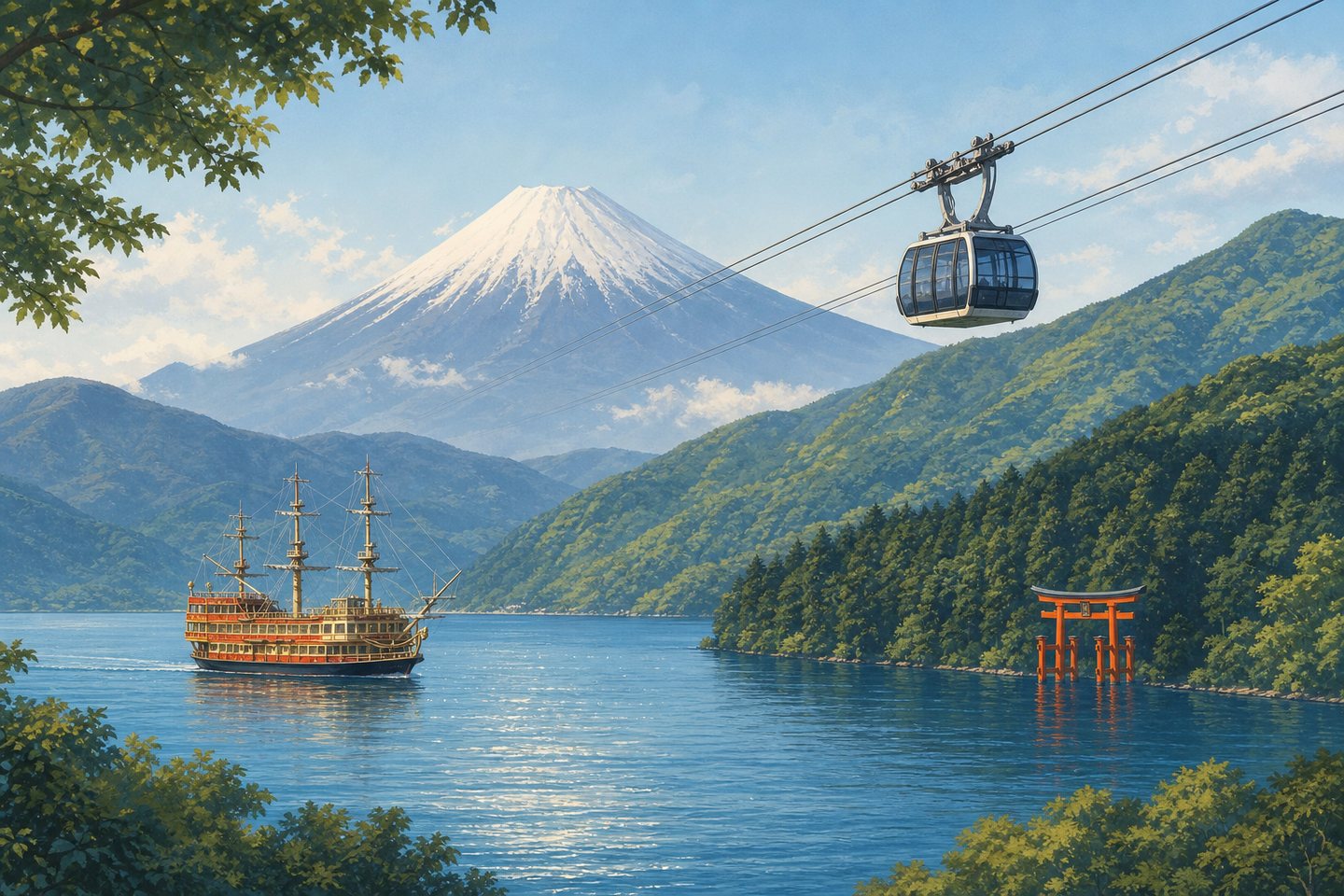
Hakone in two days: the route at a glance
The most efficient car-free route is a one-way loop:
Shinjuku → Hakone-Yumoto → Chokoku-no-Mori → Gora → Sounzan → Owakudani → Togendai → Lake Ashi/Motohakone → Hakone-Yumoto → Shinjuku
This plan works best for one or two adults who can manage several transfers and want to experience Hakone’s mountain transport as part of the trip. It is less comfortable with a large suitcase, a stroller that must be folded repeatedly, or a schedule with no room for weather-related changes.
Before leaving Shinjuku: tickets, boarding and luggage
Where to board for Hakone
The Odakyu Romancecar for Hakone-Yumoto leaves from Odakyu Shinjuku Station, not the JR platforms. Shinjuku is a large station complex, so allow extra time to find the Odakyu area, buy or collect tickets, and locate your platform.
The Romancecar is all-reserved seating and requires a limited-express ticket in addition to the base fare or Hakone Freepass. Odakyu states that the fastest Shinjuku–Hakone-Yumoto service takes 75 minutes. Reserve ahead if you need a specific departure, especially on weekends and holidays.
Which Hakone Freepass should you buy?
For this route, the two-day Hakone Freepass is usually the simplest option because it covers the Hakone Tozan Train, cable car, ropeway, Hakone Sightseeing Cruise and designated bus sections. It also includes discounts at participating attractions.
- From Shinjuku, two days: ¥7,100 adult / ¥1,600 child
- From Odawara, two days: ¥6,000 adult / ¥1,500 child
The Shinjuku version includes one round trip on the Odakyu Line between your departure station and Odawara. A Romancecar limited-express ticket is still separate. If you reach Odawara by another route, compare that total with the Odawara version of the pass.
Do not assume that a JR Pass covers this itinerary. The route uses Odakyu and Hakone-area transport rather than only JR services. Check the conditions of your exact rail pass before travel. Likewise, do not rely on tapping an IC card for every stage of the loop without checking each operator’s current rules; a Hakone Freepass avoids repeated fare decisions on this itinerary.
Do not take a large suitcase around the loop
The first day involves repeated transfers between a mountain train, cable car, ropeway and ship. A large suitcase will make the day slower and more tiring. A practical plan is to use luggage delivery from Hakone-Yumoto to your accommodation, if available for your hotel and arrival time, or store your bag in a station locker and carry an overnight bag.
Check the luggage service’s acceptance cut-off, same-day delivery area, bag-size limits and collection time on its official page before relying on it. If your Lake Ashi hotel cannot receive same-day luggage, ask the property directly about forwarding or storage before booking.
One more thing to settle before you leave Shinjuku: mobile data. Reservation pages, ropeway status and map directions are all online, and an eSIM bought in advance works from the moment you land. Get a Japan eSIM for your trip 
Day 1: Shinjuku to Owakudani and Lake Ashi
| Suggested window | Plan | Practical note |
|---|---|---|
| Early morning | Board the Romancecar at Odakyu Shinjuku Station | All seats are reserved; the limited-express ticket is separate from the Hakone Freepass |
| Morning | Arrive at Hakone-Yumoto and deal with luggage | Use hotel delivery or a locker rather than carrying a large case around the loop |
| Late morning | Hakone Tozan Train to Chokoku-no-Mori | The train climbs by switchbacks; Hakone-Yumoto to Gora takes about 40 minutes |
| Late morning to lunch | Hakone Open-Air Museum | Allow 90–120 minutes if you want both outdoor and indoor exhibits |
| Early afternoon | Lunch in Gora, then cable car to Sounzan | Gora–Sounzan takes about 10 minutes |
| Mid-afternoon | Ropeway to Owakudani | Allow 45–60 minutes around the station area |
| Late afternoon | Continue by ropeway to Togendai, then cruise to Motohakone | Confirm the day’s last ropeway and ship before setting out |
| Evening | Stay near Motohakone or Lake Ashi | This avoids reversing the mountain route the next morning |
Hakone Open-Air Museum
The museum is a two-minute walk from Chokoku-no-Mori Station. The verified opening hours are 9:00 a.m.–5:00 p.m., with last admission at 4:30 p.m. Admission is ¥2,000 for adults, ¥1,600 for university and high-school students, ¥800 for elementary and junior-high students, and free for preschool children. The official web ticket lets visitors enter without lining up at the ticket counter.
Much of the collection is outdoors. The museum can still work on a rainy day because it has indoor exhibits, but bring rain protection and allow less time outside in poor conditions.
Owakudani: what requires a reservation?
You can see the volcanic landscape from around Owakudani Station without joining the nature trail. The Owakudani Nature Research Trail is a separate, advance-reservation activity. As verified on August 25, 2026, it ran four times daily at 10:00 a.m., 11:30 a.m., 1:00 p.m. and 2:30 p.m., took about 40 minutes, and required an ¥800 cooperation fee paid cashlessly. Participants had to report to the Owakudani Information Center at least 20 minutes before the start.
The trail may be cancelled because of weather or volcanic conditions. Check the latest alert level, access restrictions and reservation details shortly before visiting. If you have asthma, respiratory or heart concerns, consult the latest official safety guidance rather than treating this itinerary as medical clearance.
Ropeway and Lake Ashi cruise
The ropeway connects Sounzan, Owakudani, Ubako and Togendai. One section takes roughly 10 minutes. Verified operating hours were 9:00 a.m.–5:00 p.m. from February through November and 9:00 a.m.–4:15 p.m. in December and January. The verified one-way adult fare was ¥2,000.
From Togendai, the Hakone Sightseeing Cruise links the north end of Lake Ashi with Hakonemachi and Motohakone. The verified adult fare from Togendai to Motohakone was ¥1,700, with a journey of roughly 25–40 minutes. Seasonal timetables and the last sailing matter more than the sample windows above, so check them on the morning of travel.
Day 2: Hakone Shrine, Hakone-Yumoto and return to Tokyo
| Suggested window | Plan | Practical note |
|---|---|---|
| Morning | Walk along Lake Ashi and visit Hakone Shrine | Going early usually fits the route better than adding the shrine late on Day 1 |
| Late morning | Bus from Motohakone to Hakone-Yumoto | Road traffic can make journey times unpredictable |
| Lunch to mid-afternoon | Lunch, shopping or a day-use onsen in Hakone-Yumoto | Confirm the individual facility’s entry rules before going |
| Afternoon | Reserved Romancecar to Shinjuku | Leave a generous buffer between the bus and your train |
Hakone Shrine’s verified service hours were 8:15 a.m.–5:00 p.m. for amulets and goshuin stamps, 8:30 a.m.–4:00 p.m. for prayer applications, and 9:00 a.m.–4:00 p.m. for the treasure hall. According to the shrine’s official access information, buses do not stop at the “Hakone-jinja-iriguchi” stop from 10:00 a.m. to 4:00 p.m.; use Motohakone-ko during that period.
If you plan to use an onsen, check the chosen facility’s current rules directly. Tattoo policies, private-bath availability, age restrictions and same-day admission vary by property, so this article does not label any facility “tattoo-friendly” without a verified official policy.
Where to stay
| Area | Best for | Trade-off |
|---|---|---|
| Motohakone / Lake Ashi | Following this loop and visiting Hakone Shrine in the morning | You need a bus alternative if the ship stops |
| Gora / Miyanoshita | Splitting the mountain section over two days | You will not finish the one-way loop on Day 1 |
| Hakone-Yumoto | Easy return travel and a weather-resistant base | You must travel back down after mountain sightseeing |
| Sengokuhara | Museums and the Togendai side of Hakone | The trip becomes more bus-dependent |
Before booking, confirm the last check-in time, nearest stop, walking route with luggage, shuttle schedule, luggage delivery acceptance and cancellation conditions on the hotel’s official site.
Bad-weather alternative: skip the exposed loop
Strong wind, thunderstorms or an approaching typhoon can stop the ropeway and sightseeing cruise. If that happens, do not try to preserve the original loop at all costs.
- Stay on the Hakone-Yumoto–Gora side, using the mountain railway where it is operating.
- Spend more time at indoor sections of the Hakone Open-Air Museum, another officially confirmed indoor attraction, or your accommodation.
- Use Hakone-Yumoto for lunch, shopping and an onsen whose day-use rules you have checked directly.
- If your hotel is near Lake Ashi, ask the property for the current bus route and allow substantial extra time.
If only Day 1 is affected, move Owakudani to Day 2 only after checking the ropeway, cruise, volcanic information and your return-train buffer. During severe weather or transport suspensions, operator instructions take priority over this itinerary.
Common questions from international visitors
Can I start from Tokyo Station instead?
Yes. One option is to travel to Shinjuku and board the Odakyu Romancecar; another is to reach Odawara and enter Hakone from there. Choose the Hakone Freepass departure point that matches your actual route. If changing at Shinjuku, remember that the Romancecar uses Odakyu Shinjuku Station, not the JR platforms.
Can I use a JR Pass to get all the way around Hakone?
Do not assume so. Most of this loop is on non-JR transport. Check the official coverage of your exact JR product and separately budget for transport not included.
Can I use Suica or PASMO everywhere?
Payment and ticket acceptance can vary by operator, route and ticket type. This itinerary does not claim universal IC-card coverage. Check current operator guidance, or use a Hakone Freepass for its covered transport and keep another payment method available.
Can I visit an onsen if I have tattoos?
Policies differ by facility and can change. Ask the specific onsen or hotel in writing before booking; also ask whether covering stickers or reservable private baths are accepted. Do not rely on a general statement about “Hakone onsens.”
What should I reserve first?
Book accommodation and any Romancecar departure you cannot afford to miss. Reserve the Owakudani Nature Research Trail only if it is important to you; the station-area viewpoint remains an option without the trail. Then recheck operating status and last services shortly before departure.
Final pre-trip checklist
- Ropeway operating status and scheduled maintenance
- Lake Ashi cruise status and the day’s last sailing
- Owakudani trail reservation and same-day operation
- Hakoneyama volcanic alert level and access restrictions
- Romancecar reservation and the separate limited-express ticket
- Luggage delivery cut-off and hotel acceptance
- Accommodation check-in, shuttle and cancellation rules
- Onsen entry and tattoo policy for the exact facility you plan to use
Official sources and verification date
Fares, operating hours and transport details in this article were checked against the following official sources on August 25, 2026. Recheck them before travel because prices, timetables, access rules and operating conditions can change.
- Odakyu Hakone Freepass
- Hakone Freepass prices and sales locations
- Odakyu Romancecar
- Hakone Navi access guide
- Hakone Tozan Train and cable car
- Hakone Ropeway
- Hakone Ropeway tickets
- Hakone Sightseeing Cruise
- Owakudani Station information
- Hakone Open-Air Museum FAQ
- Hakone Shrine
- Owakudani Nature Research Trail reservations
- Kanagawa Prefecture: Hakone and Owakudani information
- Japan Meteorological Agency: Hakoneyama volcanic activity


コメントをどうぞ